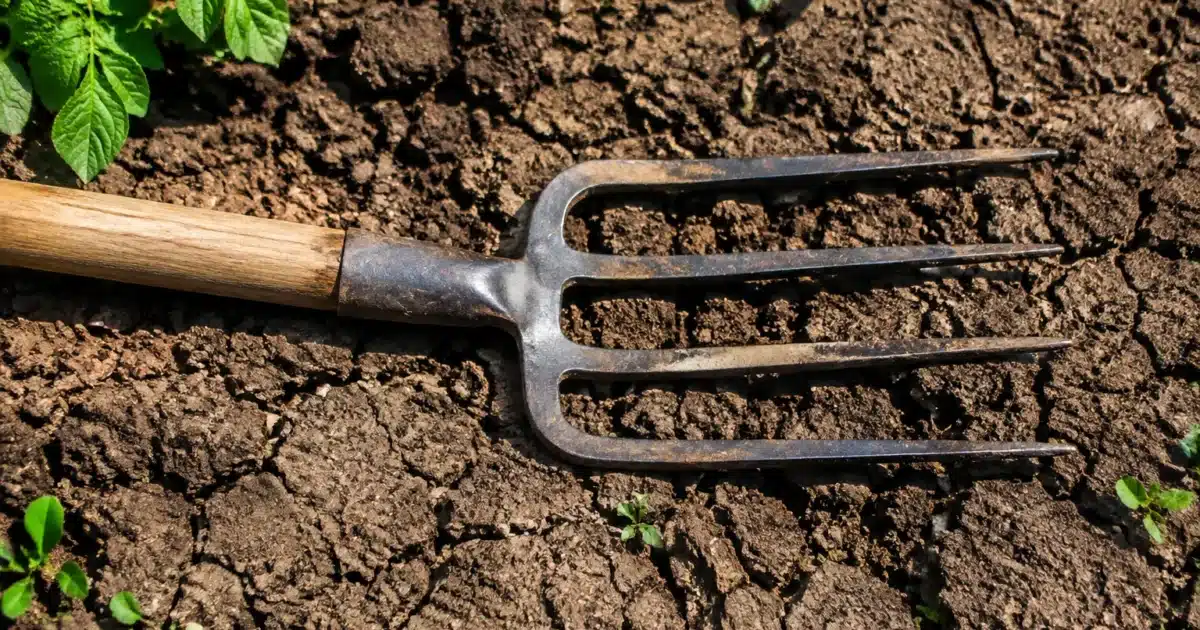
You plunge your spade in and it bounces back. The soil looks like a concrete slab, cracked on the surface, deaf beneath your feet. The usual reflex is to turn it all over with vigorous spade strokes to “open it up.” Bad idea: this earth hard as concrete after summer first needs water and patience, not brute force.
A soil compacted by drought hasn’t just lost its water. It has also lost its structure. The aggregates that allowed air and water to circulate have collapsed, especially on clay soil that shrinks as it dries and then forms a crust as soon as the first rain falls. Tilling this dry soil only makes things worse, breaking up the few remaining clods that were still holding together.
Why your hardened summer soil refuses water and turns into concrete
During the hot months, water evaporates and clay particles squeeze together like the pieces of an overly tight puzzle. Without regular rain, clay soil cracks on the surface and loses all porosity. Result: when the storm finally arrives, water runs off instead of soaking in, and a thin hard layer forms, the infamous crust, which prevents young shoots from emerging and air from circulating.
Soil texture plays a decisive role in this reaction. Clay soil stores water well but compacts violently as it dries, while sandy soil hardens less but retains very little moisture. Between the two, the presence of organic matter makes all the difference: it acts like a sponge that cushions humidity variations and protects soil structure.
Tilling immediately: the mistake that makes everything worse
Deep digging on dry soil breaks the galleries dug by earthworms, destroys the fungal filaments that link roots together, and brutally exposes microorganisms to air and sun. All this invisible soil life, essential to fertility, takes months to rebuild. You think you’re aerating, but you’re actually sterilizing part of the soil.
There’s also a perverse mechanical effect: by tilling soil that’s too dry and compacted, you bring hard blocks to the surface that will dry even faster in contact with air, and you bury the thin surface layer that contained whatever humus was available. The circle is vicious: tilling, biological exhaustion, new crust at the next rain, and a soil that becomes harder to work with each passing season.
Never kill
another plant.
Take a photo: the app names the species, spots the problem and tells you exactly what to do.
A gardener who tilled his dry soil in early September saw an even harder crust appear three weeks later, at the first heavy rain. By simply waiting for progressive watering before intervening, the soil rehydrated in depth without any need for force.
Rehydrate and decompress gently without tilling
Slow watering and false seedbed to awaken the soil
The first step is rehydration, not the tool. Slow, repeated watering, in fine rain or via drip irrigation, gives water time to descend deeply without running off the hardened crust. It’s better to water lightly but often over several days than to flood once a soil that will refuse water, unlike the habit of watering daily in summer which weakens plants.
Tap to scan your plant
This feature requires the Plantalya app. Scan any plant instantly with your camera!
Scan Your Plant — Download Free AppOnce the soil is slightly moist, the false seedbed technique makes perfect sense: you gently scratch the surface to break the crust, let weed seeds germinate, then remove them from the surface without ever touching the deep layers. This method gently reactivates soil life without traumatizing it.
Broadfork and light aeration without turning
When the soil has regained some flexibility, the broadfork becomes the reference tool for respectful decompaction. Unlike the spade, it drives its tines vertically then simply tips the soil without turning it: layers keep their order, microorganisms stay in place, and air circulates again between loosened clods.
On the most compacted areas, a broadfork pass every 20 to 30 centimeters is usually enough to break deep compaction. There’s no need to force: if the tines resist too much, it means the soil isn’t moist enough yet to be worked safely.
Never kill
another plant.
Take a photo: the app names the species, spots the problem and tells you exactly what to do.
Nourish the surface: compost, mulch and cover crops for lasting regeneration
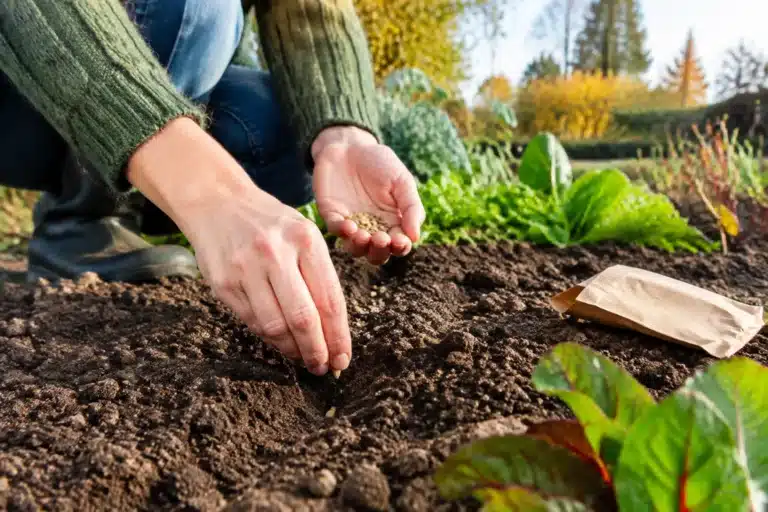
Decompacting isn’t enough if the soil stays poor, hence the value of a plant that freely nourishes the soil when the vegetable garden empties. Adding mature compost to the surface, without burying it deeply, progressively feeds the earthworms and microorganisms that will themselves integrate this organic matter into the soil profile. It’s slow work but far more lasting than brutal tilling.
Mulching naturally complements this approach: it limits evaporation, protects the surface from future crusting, and maintains stable moisture even during the next dry periods. Sowing an August cover crop that cleans the soil over winter (phacelia, mustard or vetch depending on season) goes even further, as roots penetrate deeply, mechanically structure the soil and release humus once mown.
| Method | What it provides | When to use it |
|---|---|---|
| Slow watering | Deep rehydration | First, before any soil work |
| False seedbed | Crust breaking, weed removal | After rehydration, before sowing |
| Broadfork | Decompaction without turning | On slightly moist soil |
| Compost + mulch | Fertility and lasting protection | Continuously, after decompaction |
| Cover crop | Root structuring, humus | Between two crops |
Restoring soil compacted after summer means accepting a slower rhythm than spade work. But it’s precisely this patience—progressive water, gentle tools, organic matter on the surface—that prevents repeating the same vicious cycle year after year of soil that hardens and then gets damaged a little more by trying to do the right thing.