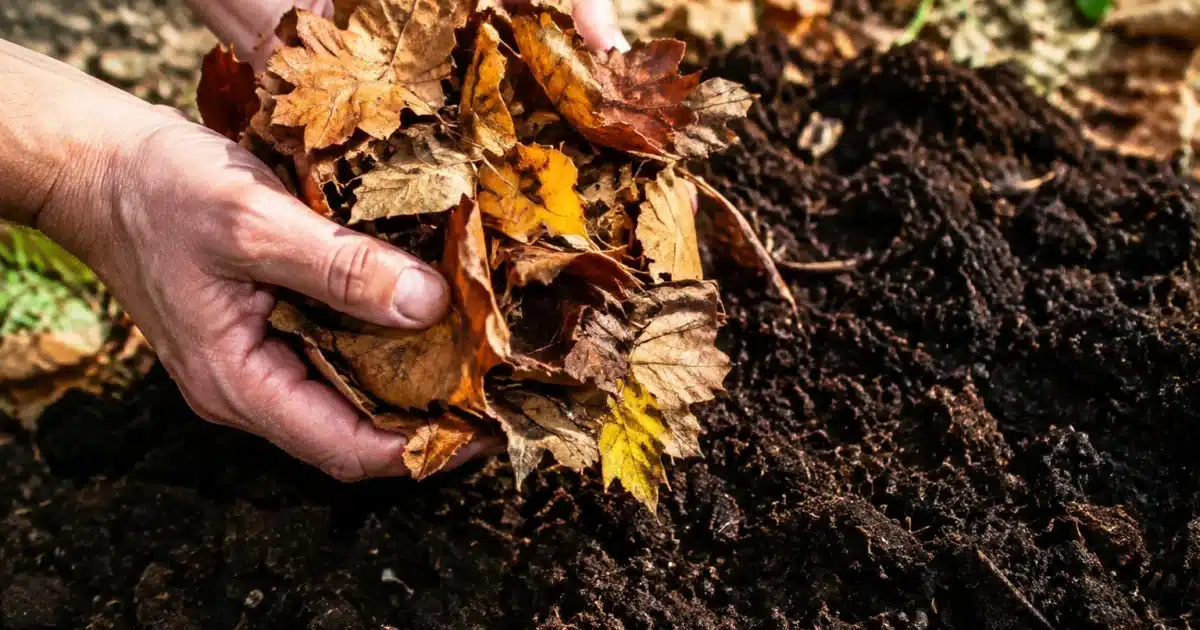
Every autumn, the same ritual repeats itself: dead leaves are raked up, bagged, and sent to the waste disposal center, when there are actually 3 places to intentionally leave dead leaves in your garden. Meanwhile, in the garden, we buy bagged soil amendments to feed the earth. The paradox is complete, because these discarded leaves are often worth more than any product sold in stores.
A handful of dead leaves can do more for your soil than some store-bought amendments. They provide carbon, a bit of nitrogen, and above all living organic matter that will nourish the soil’s microorganisms for months. Unlike an industrial amendment, they decompose slowly and release their nutrients at the pace of plant needs, with no risk of burn or imbalance.
Why dead leaves are better than commercial amendments
A bag of amendment costs money and sometimes comes from far away, whereas dead leaves are free, available on every street corner and already adapted to the local climate. They reproduce exactly what happens naturally in a forest: a layer of organic matter settles on the ground, decomposes, and gradually forms humus. This cycle, sometimes called “brown gold” by gardeners, transforms a cumbersome waste into fertile resource.
The decomposition of leaves nourishes microorganisms and earthworms, which aerate the soil deep down. Fertile soil is not built solely with occasional additions: it is constructed over time, thanks to regular organic matter contributions. Purchased amendments sometimes provide concentrated nutrients, but rarely this underground life that makes the true wealth of soil.
How to use dead leaves to enrich your soil
There are several simple ways to incorporate dead leaves into your garden, depending on the desired result: protecting the soil during winter, preparing a fertile vegetable patch, or making quality homemade potting soil.
Mulching: protecting and nourishing at the same time
Spreading a layer of dead leaves over flower beds or at the base of shrubs provides effective winter protection against frost and drying out. This mulch also limits weed growth and preserves soil moisture. As it decomposes slowly, it releases nutrients that directly benefit the roots, without going through a bag bought at a garden center, like other garden waste that replaces store-bought bags of mulch.
Burying in the vegetable garden for fertile soil
On empty vegetable patch plots, burying a good thickness of leaves before winter amounts to preparing the ground for the next season. By mixing into the soil, they promote decomposition and enrich the earth with organic matter. Covering bare soil this way also prevents nutrient leaching from winter rains, a frequent problem on soil left exposed.
Making homemade leaf mold
By piling leaves in a corner of the garden or in a large perforated bag, you obtain in one to two years a dark, crumbly leaf mold soil, close to forest humus. This homemade potting soil serves as a base for seedlings, as an amendment for pots, or as fine mulch for delicate flower beds. Simply moisten the pile regularly and turn it over occasionally to accelerate decomposition.
Never kill
another plant.
Take a photo: the app names the species, spots the problem and tells you exactly what to do.
Integrating leaves into compost to boost its quality
Dead leaves are rich in carbon, while kitchen scraps mainly provide nitrogen. This balanced mixture is exactly what an efficient compost seeks. By adding a good proportion of leaves to your compost, you prevent it from becoming too wet or too compact (an imbalance that sometimes explains why compost smells bad during the heat wave), while accelerating decomposition thanks to microorganism activity.
This simple recycling allows real savings on commercial amendments, since the compost obtained advantageously replaces many bagged products. The organic matter thus transformed then benefits the entire garden, from the vegetable patch to flower beds.
Tap to scan your plant
This feature requires the Plantalya app. Scan any plant instantly with your camera!
The mistake to avoid with plane and walnut trees
Not all leaves are equal. Those from plane and walnut trees decompose very slowly and contain compounds that slow the growth of other plants. It’s better to reserve them for compost, in small quantities, rather than using them as direct mulch on your flower beds.
Which leaves to favor (and which to avoid)
Some leaves decompose quickly and enrich the soil well, others require more patience or pose problems in large quantities:
- To favor: maple, linden, birch, fruit trees—they decompose rapidly and form beautiful humus.
- To use sparingly: oak, beech, chestnut—higher in tannins, they decompose more slowly.
- To reserve for compost in small doses: plane, walnut, laurel—less favorable as direct mulch.
On the lawn, a light pass with a mower allows you to shred fine leaves and let them decompose in place, quietly nourishing the soil without extra work.
Never kill
another plant.
Take a photo: the app names the species, spots the problem and tells you exactly what to do.
Practical tips: collecting and storing leaves
Collection is ideally done in dry weather, using a rake or a mower equipped with a bag, and is part of the points to check around the house before dead leaves and rains arrive. Wet leaves stick and are harder to work with, whereas regular collection prevents them from accumulating in too-thick a layer on the lawn or pathways.
For storage, a large perforated bag, a fenced corner of the garden, or a simple pile in a discreet spot is sufficient. The essential thing is to let air circulate to promote decomposition, while keeping the leaves slightly moist. A few months later, this stockpile becomes a precious reserve of organic matter, ready to enrich your soil without spending a cent on store-bought bagged amendments.