A single clove planted in the soil at the right time, and a few months later, an entire head emerges from the ground. The principle sounds almost too simple to be true. Yet everything hinges on a detail that many gardeners overlook: the timing of planting.
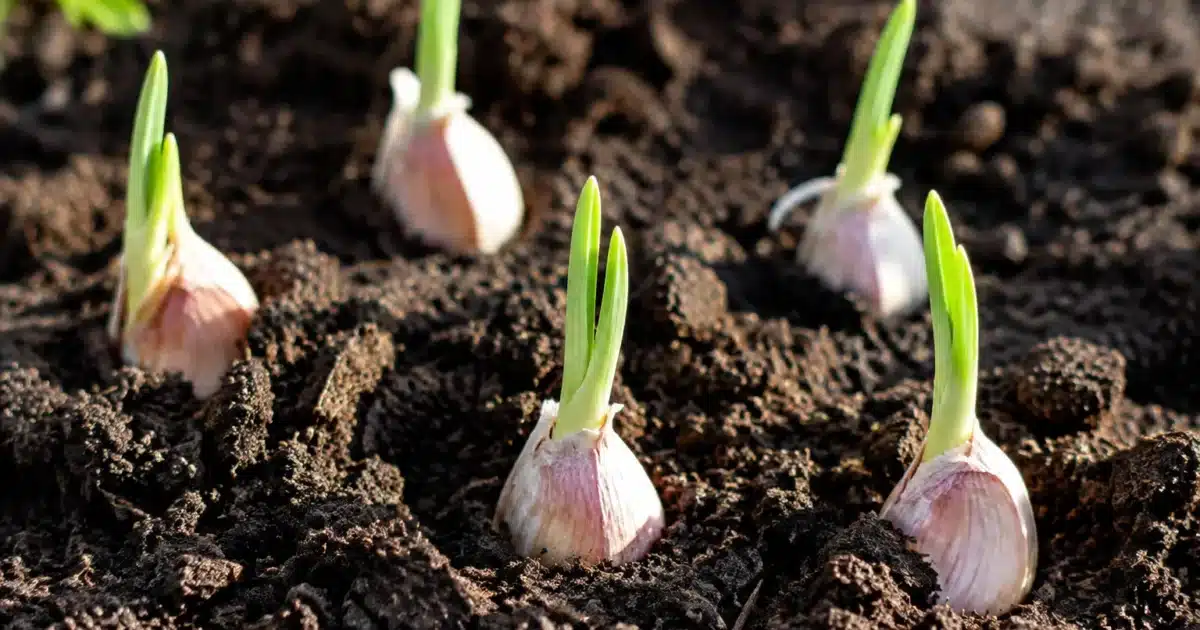
Garlic is planted mostly in autumn, between October and December depending on the region, to take advantage of the winter cold that triggers the formation of cloves. Each clove must be buried with the pointed end facing up, at a depth of approximately 3 to 5 cm, spacing rows 20 cm apart and cloves 10 to 15 cm apart. This exposure to cold, called vernalization, prompts the plant to divide its bulb into multiple cloves instead of remaining a single mass.
Why garlic is planted in autumn (and sometimes in spring)
Cold is not just a meteorological detail for garlic; it’s a biological trigger. Without a sufficiently cool dormant period, the plant doesn’t receive the signal needed to form well-divided heads. This is why autumn planting remains the standard for most varieties cultivated in France, especially since leaving a vegetable garden bed empty until spring is a mistake when you can plant garlic there.
Spring varieties do exist, however, adapted to regions where winters are too mild or too late. They are then planted in February-March, but generally produce slightly smaller heads due to a shorter vernalization cycle. In a typical vegetable garden, autumn planting is preferable if the climate allows it.
White, purple, or pink garlic: which variety to choose?
The three main garlic families don’t behave exactly the same way in the soil. White garlic is the most common, hardy, and well-suited to traditional autumn planting. Purple garlic, often more aromatic, produces a flowering stem that sometimes needs to be cut to concentrate the plant’s energy into the bulb rather than the flower.
Pink garlic, which matures later, is generally harvested after the other two and stands out for its particularly long storage life. The choice mainly depends on the local climate and intended culinary use, but all these varieties follow the same principle: the better the vernalization, the larger and better-formed the heads will be.
| Variety | Planting Period | Characteristic |
|---|---|---|
| White garlic | October to December | Hardy, versatile |
| Purple garlic | October to December | Aromatic, produces a flowering stem |
| Pink garlic | November to January | Late harvest, long storage life |
How to plant garlic step by step
Preparing cloves and soil
Each garlic head must be separated into cloves just before planting, keeping only the largest and healthiest ones. Small, damaged, or soft cloves should be discarded, as they will produce weak bulbs. The soil must be loose and especially well-draining: garlic hates stagnant moisture, which promotes rot of the cloves before they even take root.
Heavy, clayey soil can be lightened with sand or well-decomposed compost, as mentioned in what gardeners of old put at the bottom of planting holes in August. In a vegetable garden where water tends to pool, a raised bed often makes all the difference in successful cultivation.
Never kill
another plant.
Take a photo: the app names the species, spots the problem and tells you exactly what to do.
Depth, spacing, and orientation
The rule is simple to remember: the pointed end of the clove must always face upward, buried at a depth of 3 to 5 cm below the surface. Spacing of 10 to 15 cm between each clove and 20 cm between rows provides enough room for each bulb to develop without excessive competition for nutrients.
A clove planted too close to the surface risks being heaved out by frost or rain, while a clove buried too deep will take longer to emerge and will weaken the young shoot.
What happens underground: from clove to head
Once in the soil, the clove quickly develops roots, then enters dormancy during the coldest months. It’s precisely this period of apparent rest that is decisive: beneath the surface, the cold slowly works on the clove’s tissue and prepares for the future division of the bulb.
As the weather warms, a green shoot emerges and the plant begins active growth. This is when the original clove truly begins its transformation, gradually multiplying into several cloves that will form together the final garlic head. Some varieties also produce a flowering stem bearing bulbils, a form of aerial multiplication sometimes used to renew one’s seed stock.
Tap to scan your plant
This feature requires the Plantalya app. Scan any plant instantly with your camera!
On purple garlic varieties in particular, it is advisable to break off the flowering stem as soon as it appears. This prevents the plant from dispersing its energy into the flower instead of concentrating it on forming the underground bulb.
Harvesting and storage for whole heads
The harvest signal is visual: when the foliage begins to yellow and fall over, generally in June or July depending on the variety and region, it’s time to pull up the heads. Partial yellowing, with a few green leaves still present, is ideal: waiting for complete drying weakens the protective layers of the cloves.
After harvest, the heads must dry for several days in a well-ventilated spot away from direct sunlight before being stored. Good storage requires a dry, cool, and well-ventilated location where heads can be kept for several months without sprouting or molding.
Never kill
another plant.
Take a photo: the app names the species, spots the problem and tells you exactly what to do.
Mistakes to avoid for well-formed heads
The temptation to pull up the garlic too early, as soon as the first leaves begin to yellow slightly, is common but counterproductive. Early harvesting produces heads that are still poorly formed, with underdeveloped cloves and poor storage potential. It’s better to wait until the proper yellowing stage rather than give in to impatience.
Other common mistakes mainly concern soil that’s too wet, insufficient spacing that starves plants competing with one another, and using cloves from commercial food sources rather than seeds dedicated to the vegetable garden. The latter are sometimes treated against germination, which directly compromises cultivation.