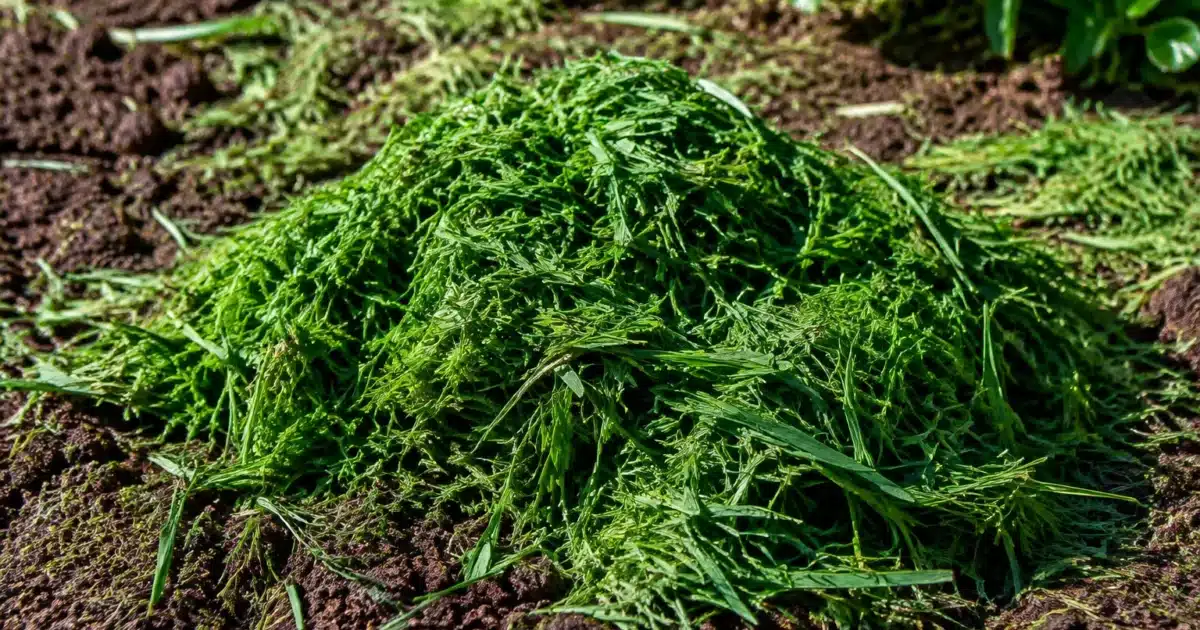
That bag of clippings sitting next to the green bin—you know the one. What if that freshly cut grass were worth more than you think? It can feed your lawn, protect your flower beds, enrich your compost, and even replace store-bought fertilizer. Here are four concrete ways to put it to good use instead of tossing it out.
1. Mulching: Mow Without Bagging to Feed Your Lawn
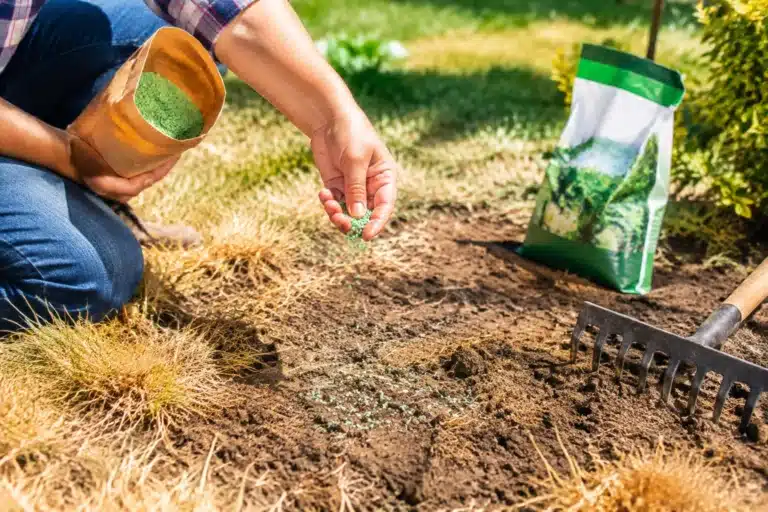
The simplest method remains the one that requires the least handling: mulching. It involves mowing without collecting the clippings, letting the finely shredded grass fall directly back onto the lawn. This technique requires a mower equipped with a mulching kit or adapted blade, capable of cutting the blades multiple times before depositing them back on the ground.
As they decompose, these residues release nitrogen that is directly absorbed by the grass. It’s a natural fertilizer that’s completely free and significantly reduces the need for external inputs. The finely cut grass also acts as a light mulch that limits evaporation and preserves soil moisture, especially useful during hot periods.
The only point to watch: mow more frequently, with small regular cuts. If the grass is too tall, the residues will form clumps that smother the lawn instead of feeding it.
2. Mulching Flower Beds and Vegetable Gardens
Lawn clippings make perfect mulch for flower beds, borders, and vegetable gardens, much like other garden waste that replaces store-bought mulch bags. Spread at the base of plants, they limit weed growth, maintain soil moisture, and gradually transform into organic matter. It’s an economical way to recycle what your lawn produces each week.
The detail that makes all the difference: thickness and drying. A fresh layer applied too thickly will ferment, heat up, and produce an unpleasant odor while forming an impermeable crust. It’s better to let the grass dry for a day or two before spreading it in a thin layer of two to three centimeters, in several successive passes rather than all at once.
In the vegetable garden, this mulch protects the base of tomatoes, zucchini, or lettuce from soil splashing during watering, which limits certain fungal diseases. Around shrubs, it can also complement a dry hedge made of branches and wood chips, creating a mixed mulch that decomposes at different rates.
3. Composting Lawn Clippings
Never kill
another plant.
Take a photo: the app names the species, spots the problem and tells you exactly what to do.
Composting clippings remains one of the most well-known solutions for putting these green waste to good use, as long as you follow a few simple rules. On their own, fresh clippings are too rich in water and nitrogen: they compact the compost, drive out air, and end up rotting rather than decomposing properly.
Balance Green and Brown Matter
The key to successful compost lies in the balance between nitrogen-rich and carbon-rich materials. Lawn clippings, which are nitrogen-rich, should be mixed with brown materials like fallen leaves used as free soil amendment, cardboard, straw, or wood chip shavings. A good rule is to alternate layers, using about two volumes of brown matter for every one volume of fresh clippings.
This mixture promotes the work of microorganisms responsible for decomposition, while maintaining an aerated structure that prevents bad odors. Well-managed compost, turned over occasionally, yields rich, free compost within a few months that is perfectly suited to your garden’s needs.
Tap to scan your plant
This feature requires the Plantalya app. Scan any plant instantly with your camera!
The mistake that makes compost rot
Adding only fresh clippings in large quantities creates a compact, slimy mass. Always remember to mix them with dry materials and regularly aerate the pile.
4. Lesser-Known Alternative Uses
Beyond the classic trio of mulching, mulch, and compost, grass clippings offer other uses that often go overlooked even though they’re part of the free resources available in any garden.
Never kill
another plant.
Take a photo: the app names the species, spots the problem and tells you exactly what to do.
Herb Liquid and Animal Feed
Grass liquid is made by letting fresh clippings soak in water for one to two weeks, then straining the liquid. Diluted, it serves as a nitrogen-rich liquid fertilizer to stimulate the growth of leafy vegetables and potted plants. It’s an eco-friendly alternative to chemical fertilizers, easy to make from what would otherwise be thrown away.
If you raise chickens, rabbits, or goats, freshly cut grass can also supplement their diet, provided it comes from an untreated lawn. Distributed in moderation and never fermented, it provides a good dose of fiber and helps, in its own way, to feed the biodiversity that orbits your garden.
| Use | Preparation Required | Main Benefit |
|---|---|---|
| Mulching | None, mow without bagging | Natural lawn fertilization |
| Mulch | Dry 1 to 2 days, thin layer | Soil protection, less watering |
| Compost | Mix with brown matter | Rich compost in the long term |
| Grass Liquid | Soak 1 to 2 weeks | Free liquid fertilizer |
Recycling your lawn clippings closes a small virtuous cycle in the garden: what grows nourishes what grows next. Between mulching, mulch, compost, and grass liquid, there’s always a solution suited to the amount produced, without ever needing to fill a bag for the recycling center.