

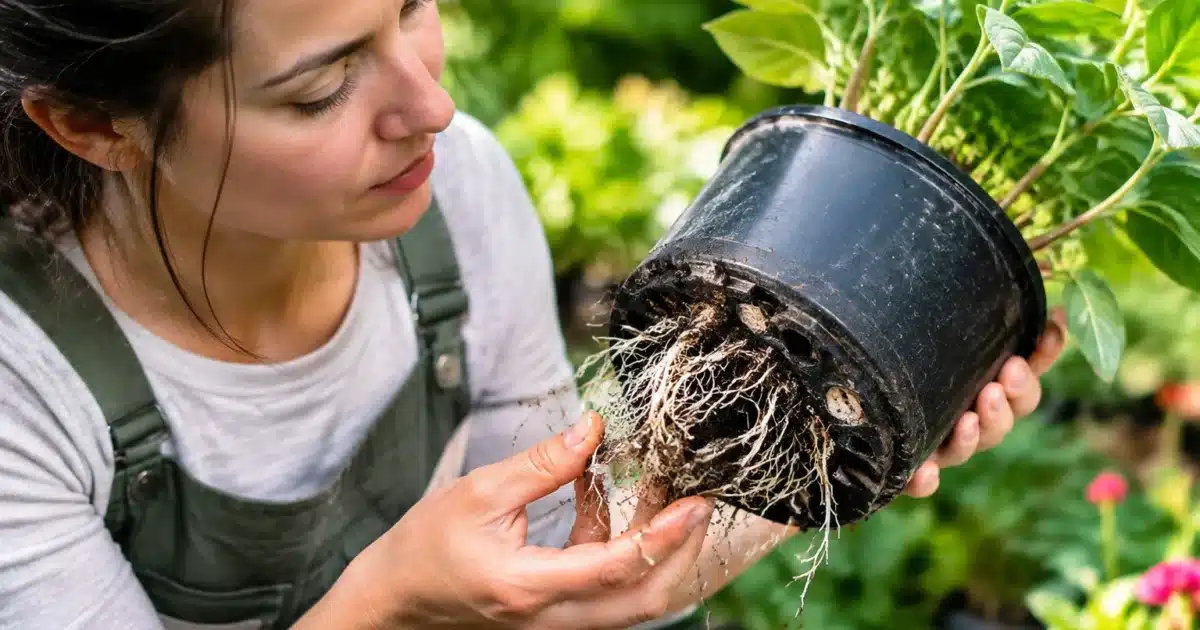
A plant that looks stunning at the garden center can die six months after planting. The reason is almost always hidden beneath the pot, where nobody looks. Professionals always start there first.
Before even judging the foliage or flower color, a nurseryman removes the plant from its pot or slides a finger into the drainage holes. He’s looking for three precise things: white and supple roots, a complete absence of root-bound growth, and a root system proportionate to the container size. If any of these criteria are missing, the plant goes back on the shelf, even if it’s on sale.
Why inspect roots before buying: the reflex of nursery professionals
Roots represent the invisible half of a plant, but they determine its entire ability to establish after planting. Green, dense foliage can mask poor rooting for several weeks while the plant exhausts its reserves. Once planted in the garden, a plant with damaged roots struggles to absorb water and nutrients, and its development stalls permanently (a phenomenon not to be confused with the roots of previous crops that remain in the vegetable garden, which aren’t always worth removing).
This is why professionals examine the root system before anything else. In a nursery, the check is often done by discreetly removing a few specimens from the same batch: if the roots are healthy on one, they’re usually healthy on the entire series produced under the same conditions.
Root-bound specimens: the number one defect to detect
Root-bound growth, also called circling roots, forms when a plant stays too long in a container that’s too small. The roots, blocked by the walls, begin to spiral around themselves instead of spreading out. The result is a compact, rolled-up mass, sometimes woody, that replaces a normally radiating root system.
How to spot root-bound growth through the pot
Certain signs are visible without even removing the plant from its pot. Roots circling out through the drainage holes, a pot that has slightly warped under pressure, or aerial roots visible on the soil surface are all signs of cramped rooting. A good reflex is to gently lift the root ball to observe the base: if it looks like a compact, brownish nest, it’s better to move on.
Why root-bound growth condemns a plant long-term
Once in the ground, circling roots often continue to spiral rather than colonize the surrounding soil. The plant literally strangles itself as its trunk thickens, which weakens its anchoring and wind resistance. This defect almost never corrects itself once planting is done, which is why nurserymen insist on eliminating it at purchase.
The discreet removal test
At a garden center, nothing prevents you from gently sliding the root ball out of the pot to check the roots’ condition, as long as you put it back afterward. A vendor used to this kind of check won’t object: it’s exactly what a nurseryman would do before approving a batch.
Never kill
another plant.
Take a photo: the app names the species, spots the problem and tells you exactly what to do.
Healthy roots: what they look like and where to look
Healthy roots display a light color, often white or cream depending on the species, and a firm texture to the touch. They spread fairly regularly from the base of the trunk or stem, without knots or dark zones that would betray rot linked to overwatering. A slight earthy smell is normal; a musty or fermented smell is not.
The best place to observe them is the bottom of the container: a few white roots slightly protruding through the drainage holes show that the plant has had time to root without being left too long in the pot. Conversely, a root ball that crumbles and doesn’t hold together signals still-too-young rooting, which isn’t necessarily serious if the plant was recently repotted.
Tap to scan your plant
This feature requires the Plantalya app. Scan any plant instantly with your camera!
Scan Your Plant — Download Free AppPot size and roots: the balance to verify
A good nurseryman always looks at the consistency between the pot size and the plant’s caliber. A young specimen planted in an oversized container often hasn’t had time to develop a dense root system, and the soil stays too moist around still-sparse roots. Conversely, a plant obviously too large for its pot has a strong chance of having developed root-bound growth, due to untimely repotting.
The ideal balance is when a root ball holds firmly when removed from the pot, without collapsing or resembling a frozen root block. This detail, often overlooked by rushed buyers, makes all the difference in the plant’s establishment in the months that follow (on this subject, discover what to put at the bottom of the planting hole in August to encourage this rooting).
Special case of container or root-ball trees
For trees, the question differs depending on production method. Specimens sold as root-balls, unearthed in open ground and wrapped in burlap, have a naturally more spread-out root system but one that’s more fragile in transit. Those sold in containers have roots confined since their earliest stages, with a higher risk of root-bound growth if the tree remained too long without repotting.
Bare-root specimens, reserved for certain species and a specific dormant period, allow a complete inspection of the root system before purchase, which explains why many professionals prefer them despite a shorter planting window. In all cases, the trunk caliber must remain consistent with the available root volume: a thick trunk on a root ball or container that’s too small is an immediate warning signal.
Never kill
another plant.
Take a photo: the app names the species, spots the problem and tells you exactly what to do.
Other quality signals (foliage, trunk, branching)
Roots don’t tell the whole story on their own. Dull, yellowed foliage or foliage covered in spots often accompanies an underlying root problem, while a straight trunk and balanced branching indicate careful nursery cultivation. Nurserymen systematically cross-reference these observations with root condition before approving a batch for sale.
In store, taking a few minutes to look under the pot before checking out prevents many disappointments in the garden. A plant with healthy roots sometimes costs a few dollars more, but it establishes and grows without dragging the invisible weaknesses of a poor start.


