

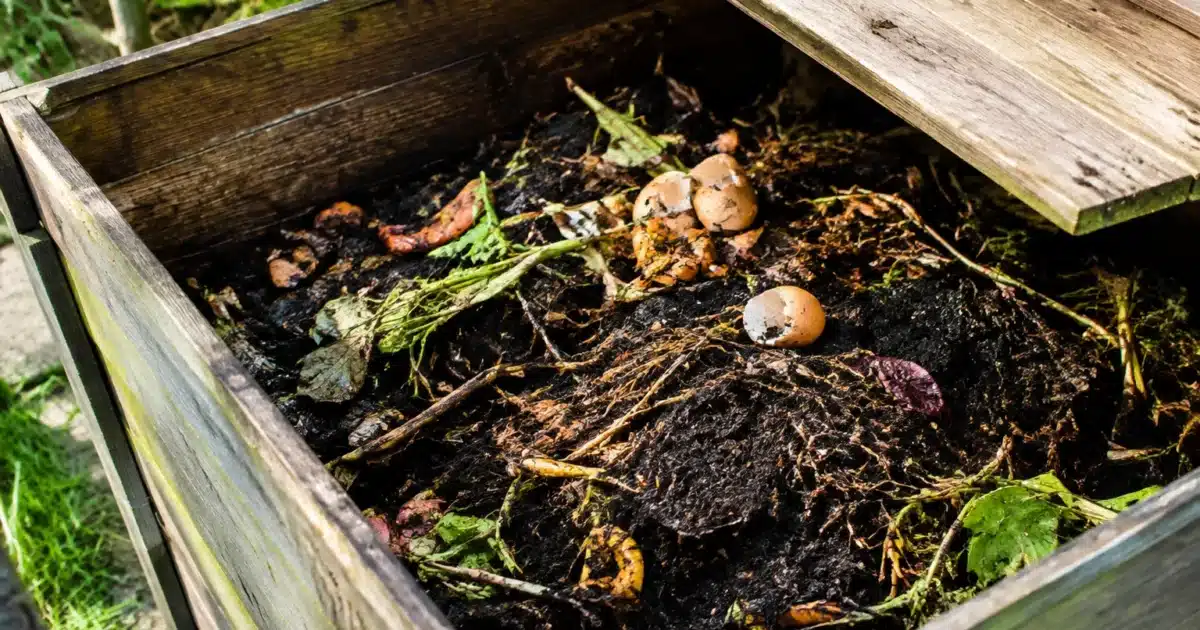
A rotten egg or ammonia smell wafts up every time you lift the compost bin lid? Don’t worry, it’s not inevitable. Healthy compost smells like moist earth and forest floor, nothing more. If that’s not what you’re getting, three causes account for almost every case, and all of them can be fixed with a few simple steps.
The smell comes from either excess moisture causing anaerobic decomposition, a lack of aeration that starves microorganisms of oxygen, or an imbalance between nitrogen-rich and carbon-rich materials (on this subject, find out why your compost has smelled bad since the heat wave, an often overlooked cause). Identifying which of the three you’re dealing with usually solves the problem with just one intervention.
Why your compost smells bad: the 3 main causes
1. Too much moisture: anaerobic fermentation
Waterlogged compost prevents oxygen from circulating through the materials. The bacteria that thrive on air give way to other microorganisms—those that work without oxygen. This anaerobic fermentation typically releases a rotten egg smell, a sign that sulfur in the waste transforms into noxious gas instead of breaking down properly.
Excess moisture often comes from fresh grass clippings dumped in thick layers, or exposure to rain without protection. The pile compacts, water pools at the bottom, and the process stalls.
2. Lack of aeration and oxygen
Even without excess water, overly compact compost deprives aerobic microorganisms of oxygen. Without air circulation, decomposition slows and the same unpleasant chemical reactions take hold. This often happens in sealed bins that are never turned, where fine materials eventually form a dense, airtight mass.
3. Carbon-to-nitrogen imbalance (nitrogen excess)
Compost needs balance between carbon-rich materials (dead leaves, cardboard, wood chips) and nitrogen-rich materials (kitchen scraps, grass clippings, fresh green waste). When nitrogen dominates, the excess converts to ammonia, recognizable by its sharp, throat-catching smell. The ideal carbon-to-nitrogen ratio is around 25 to 30 volumes of carbon materials to 1 volume of nitrogen materials.
How to identify the exact cause of the smell
The type of odor itself provides a good clue. A rotten egg smell points to excess moisture and lack of oxygen. A sharp, ammonia-like smell reminiscent of urine betrays a nitrogen imbalance. A musty or stale smell often signals both problems combined.
The squeeze test remains the most reliable way to judge moisture. Grab a handful of compost from the center of the pile and squeeze hard. If water runs between your fingers, it’s too wet. If nothing comes out and the material crumbles without compacting, it’s too dry. The ideal texture resembles a wrung-out sponge: moist to the touch, with no dripping water.
| Smell type | Likely cause | Immediate action |
|---|---|---|
| Rotten egg | Excess moisture, lack of oxygen | Turn the compost, add dry carbon |
| Sharp ammonia | Excess nitrogen materials | Add cardboard, dead leaves, or wood chips |
| Musty, stale | Moisture plus compaction | Aerate and rebalance at the same time |
Concrete solutions to fix smelly compost
Never kill
another plant.
Take a photo: the app names the species, spots the problem and tells you exactly what to do.
When faced with waterlogged, suffocating compost, the first step is to turn the entire pile with a pitchfork to recreate air circulation. This move reintroduces oxygen and restarts the activity of aerobic microorganisms. Take the opportunity to work in dry carbon materials—torn cardboard, wood chips, or dead leaves for the soil—which will absorb excess water, knowing that a handful of dead leaves can enrich your soil far better than many commercial amendments.
If the imbalance comes from excess nitrogen, the solution is to rebalance by adding those very same carbon-rich materials. Unprinted cardboard, cut into small pieces, works particularly well because it absorbs moisture while adding carbon. Commercial compost accelerator or already-mature compost can also speed up recovery by reintroducing an active population of microorganisms.
In severe cases, where the pile has reeked for several days, it’s best to empty the entire composter, spread the contents to aerate fully, then rebuild it in alternating layers of green and brown materials. This complete reset generally solves the vast majority of odor problems within one to two weeks.
Tap to scan your plant
This feature requires the Plantalya app. Scan any plant instantly with your camera!
Scan Your Plant — Download Free AppThe classic grass clipping mistake
Dumping a thick layer of fresh grass clippings all at once is the most common mistake. They compact, form an impermeable block, and start smelling within hours. Spread them in thin layers, always mixed with carbon-rich materials.
Common mistakes that perpetuate the problem
Certain habits prolong trouble without you realizing it. Continuously adding unsuitable waste like dairy, meat, or large amounts of citrus disrupts the bin’s balance and attracts pests. Never turning the compost, thinking nature will handle it alone, encourages compaction and progressive suffocation of the deeper layers.
A poorly positioned composter—in full sun or completely shielded from rain with no watering—also throws moisture out of balance. The ideal location is partial shade, with direct soil contact to allow worms and soil microorganisms to colonize the pile.
Never kill
another plant.
Take a photo: the app names the species, spots the problem and tells you exactly what to do.
Preventing odors: good daily habits
The best way to avoid unpleasant surprises is to systematically alternate your additions. Every time you add kitchen waste or fresh clippings—nitrogen-rich materials—balance it with an equivalent amount of carbon-rich materials like cardboard, straw, or dead leaves. This simple habit naturally keeps your carbon-to-nitrogen ratio in the right range.
Turning your compost every two to three weeks ensures regular aeration and prevents the buildup of compact zones. Finally, monitor overall moisture: a pile drying too quickly in summer can be lightly watered, while excess rain in winter calls for a cover or additional dry materials. These habits, once established, transform a finicky composter into a discreet, odor-free ally at the back of your garden.


