

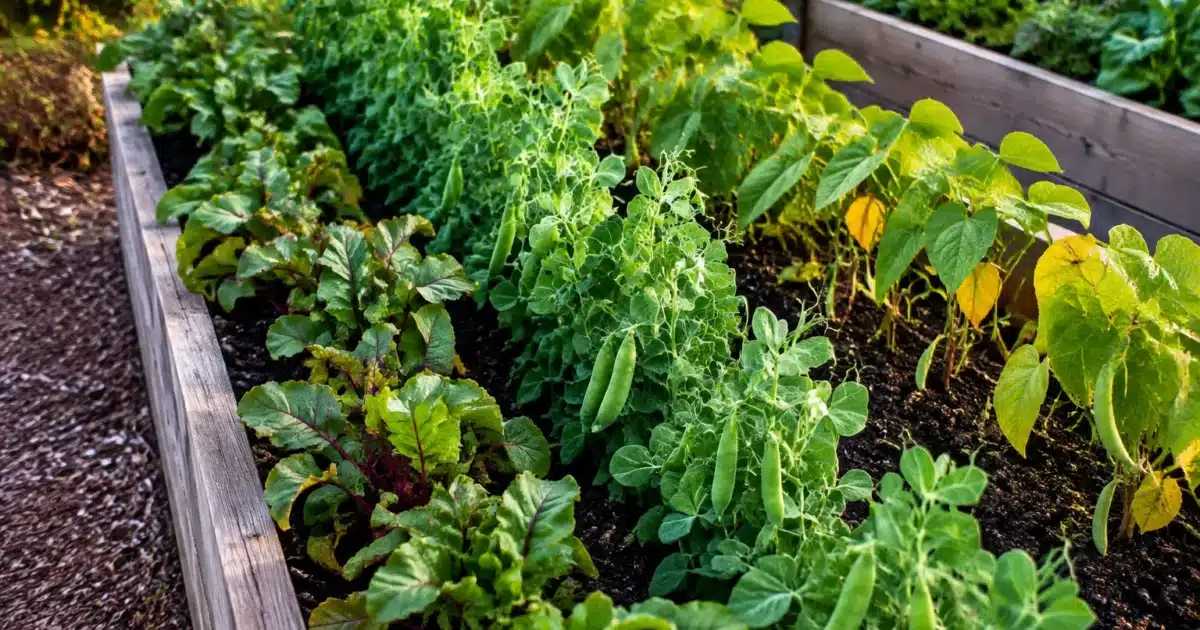
Tomatoes have given their last fruits, zucchini are slowing down, beans are running out of steam. The raised bed is emptying, but the season isn’t over: discover these 7 vegetables to sow when your summer garden empties to keep harvesting through the cold months. Here’s how to fill it intelligently right through winter, without exhausting soil that has already produced so much.
The answer lies in eight easy-to-grow vegetables starting in late summer: spinach, lamb’s lettuce, fall lettuces, winter radishes, turnips, late carrots, garlic and onions. Each belongs to a botanical family different from the nightshades, cucurbits and legumes that have just occupied the space, which allows you to respect crop rotation and avoid soil depletion.
Why and how to practice crop rotation in a raised bed
A raised bed is a restricted space where the same squares often return to the same plants if you’re not careful. Yet each botanical family draws specific elements from the soil and attracts its own pests. Planting nightshades (tomatoes, eggplants, peppers) or cucurbits (zucchini, cucumbers) twice in a row in the same spot encourages soil diseases and depletes the same nutrients year after year.
Crop succession involves following a demanding family with a lighter one, or with vegetables that restore what the previous ones consumed. After tomatoes or zucchini, hungry for nitrogen and potassium, we favor leafy vegetables or root vegetables that require fewer inputs. After beans, a legume family plant capable of fixing atmospheric nitrogen in the soil through its roots, you can conversely install vegetables that benefit from this restored richness.
The 8 best vegetables to plant after tomatoes, zucchini and beans
These eight fall and winter vegetables fall into three complementary groups, easy to organize in the free squares of a raised bed.
Leafy vegetables: spinach, lamb’s lettuce, fall lettuces
Spinach is sown directly in place from late August through October and handles cold well. Lamb’s lettuce tolerates light frosts and is harvested all winter in small quantities, making it a sure bet for filling a tight square. Fall lettuces, specific varieties adapted to short days, complete this trio of fast-growing leaves, ready in six to eight weeks.
Root vegetables: winter radishes, turnips, carrots
Winter radish, larger and longer-storing than its spring cousin, is sown until September. Turnips follow the same calendar and particularly appreciate soil that has just hosted beans, rich in nitrogen. Late carrots, sown before mid-August in the mildest regions, complete their cycle under light mulch protection.
Bulb vegetables: garlic, onion, shallot
Garlic is planted in fall for harvest the following summer, allowing you to occupy a square during the quiet period without special care. White onion and shallot follow the same fall planting logic, both undemanding and little affected by diseases from nightshades or cucurbits that preceded them.
Never kill
another plant.
Take a photo: the app names the species, spots the problem and tells you exactly what to do.
| Vegetable | Botanical Family | Planting Period | Days to Harvest |
|---|---|---|---|
| Spinach | Amaranthaceae | Late August to October | 6 to 8 weeks |
| Lamb’s lettuce | Valerianaceae | August to September | 8 to 10 weeks |
| Fall lettuces | Asteraceae | August to September | 6 to 8 weeks |
| Winter radish | Brassicaceae | Until September | 6 to 8 weeks |
| Turnips | Brassicaceae | August to September | 8 to 10 weeks |
| Late carrots | Apiaceae | July to mid-August | 10 to 12 weeks |
| Garlic | Amaryllidaceae | October to November | 8 to 9 months |
| White onion | Amaryllidaceae | September to October | 7 to 8 months |
Vegetables to avoid after summer crops (same botanical family)
After tomatoes, it’s best to keep away eggplants and peppers, other nightshades susceptible to late blight and the same soil fatigue. After zucchini, avoid cucumbers, melons and squash, all cucurbits that share the same deficiencies and pests. After beans, set aside peas and fava beans, also legumes, to avoid repeating the same drain on the soil.
These brassicas that often return in late summer also deserve special consideration: brassicas like radishes and turnips, they should not succeed each other from one season to the next in the same square, as this favors clubroot.
Tap to scan your plant
This feature requires the Plantalya app. Scan any plant instantly with your camera!
Cover crops and amendments to regenerate raised bed soil
When a square remains empty for more than a few weeks before winter, this August sowing that cleans the soil after zucchini such as phacelia or white mustard allows you to regenerate the soil without harvesting anything. Sown densely, it covers the earth, limits weeds and will be mowed then incorporated before the next plantings, bringing organic matter and structure to the soil.
An application of well-ripened compost before each new crop remains the simplest gesture to restore fertility to a raised bed worked all summer. Light amendment generally suffices between two quick crops like radishes or lamb’s lettuce, while garlic and onion, installed for several months, appreciate enriched but well-drained soil, without excess fresh nitrogen that would favor foliage at the expense of the bulb.
The mistake that rots fall harvests
Sowing too densely after a summer crop leaves compacted, damp soil that promotes seedling damping off. Loosening the soil a few centimeters before replanting, without turning it over deeply, is enough to avoid this common late-season problem (on this subject, systematically removing the roots of old crops isn’t always necessary anyway).
Never kill
another plant.
Take a photo: the app names the species, spots the problem and tells you exactly what to do.
Practical organization: calendar and layout of 8 vegetables in the raised bed
In a classic raised bed divided into nine or sixteen squares, it’s possible to distribute these eight vegetables according to their growth speed and planting density. Squares freed by tomatoes, often the largest, work well for garlic or onions that will remain in place all fall and winter. Those left by zucchini, more central, gladly welcome lettuces or spinach that need a bit more light.
The spots where beans grew, enriched with nitrogen, are perfect for turnips and winter radishes that benefit from this reserve. A planting plan noted in a notebook, even a rough one, avoids repeating the same mistakes the following year and makes crop rotation easier over several seasons. By tightening planting density slightly for fast-growing leafy vegetables, you can even fit two waves of lamb’s lettuce or radishes before the first serious frosts.


