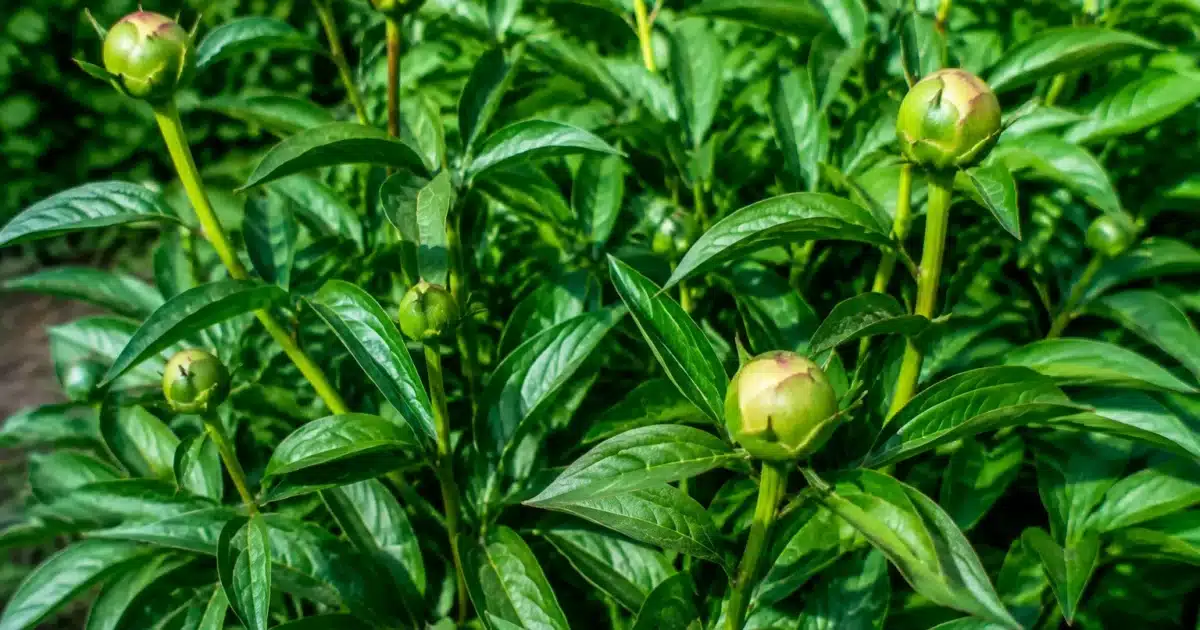
Beautiful green foliage, lush and healthy. Yet almost no flowers, year after year. This situation frustrates countless gardeners, even though peonies have a reputation for being indestructible plants. Good news: in most cases, a single mistake explains everything, and it’s fairly easy to correct.
Mistake number 1: planting too deep
This is by far the most common cause. When a peony fails to bloom despite vigorous foliage, the problem almost always comes down to planting depth. The eyes of the peony—those small reddish buds visible on the rootstock—must remain very close to the soil surface. When buried too deep, they continue to produce leaves thanks to the root’s reserves, but they don’t receive the thermal signal necessary to trigger flowering.
Why a few centimeters make all the difference
The rule is precise: the buds should not be buried more than 3 to 5 centimeters below the surface. Beyond that, the plant poorly perceives soil temperature fluctuations in spring, a signal that is essential for launching flower bud formation. A peony planted too deep can thus live for years, develop beautiful foliage, and never bloom properly. This is particularly common after a poorly executed transplant or division, when the peony rootstock is replanted without checking this benchmark.
How to correct the depth without killing the plant
No need to panic and dig everything up. In autumn, the ideal time to intervene, you can gently clear the soil around the crown to observe the position of the eyes. If the burial depth significantly exceeds 5 centimeters, a complete removal followed by shallower replanting remains the most reliable solution. This operation is often a good opportunity to divide overgrown clumps and restore vigor to the root system.
The peony eyes should be flush with the surface, almost visible to the naked eye once the soil is in place, a principle very similar to that part of the iris which must remain visible to avoid compromising its blooming. Too many gardeners add potting soil on top each autumn, without realizing they are progressively burying the crown year after year.
Never kill
another plant.
Take a photo: the app names the species, spots the problem and tells you exactly what to do.
Insufficient sunlight and poor location
The second very common cause: inadequate light exposure. The peony needs at least six hours of direct sun per day to bloom generously. In the partial shade of a tree that has grown over time, or against a wall that casts afternoon shade, it continues to produce foliage, but flowering drops significantly. If the location has become shadier over the years, relocating to a sunnier spot in the garden, always in autumn, often restores results by the following spring.
Excess nitrogen: when fertilizer feeds leaves at the expense of flowers
Soil too rich in nitrogen pushes the plant to prioritize foliage over flowers. It’s a classic gardening problem: you want to do the right thing, you add fertilizer or fresh compost rich in nitrogen, and the result is a lush peony with almost no flower buds. For blooming, the plant mainly needs phosphorus and potassium, two nutrients that promote flower bud formation rather than vegetative growth.
Tap to scan your plant
This feature requires the Plantalya app. Scan any plant instantly with your camera!
Scan Your Plant — Download Free App| Element | Effect on peony |
|---|---|
| Excess nitrogen | Abundant foliage, few or no flowers |
| Phosphorus | Promotes flower bud formation |
| Potassium | Strengthens resistance and blooming quality |
Well-aged compost, applied moderately in autumn, remains preferable to standard nitrogen-based lawn fertilizer. A balanced soil, neither too poor nor too nutrient-rich, delivers far better long-term results than a massive and imbalanced application.
Other mistakes that block blooming
Pruning and foliage interference
Cutting foliage too early in the season deprives the plant of the reserves it builds for the following year, a risk shared by these 9 shrubs that are better left alone to avoid removing their future flowers. The peony’s roots store the energy needed for future blooming thanks to leaves that remain active until autumn. Early pruning, or overly severe cutting after flowering, can therefore directly penalize next year’s buds, as clearly shown by the example of that one extra snip of the pruner that prevents the hydrangea from reflowering.
Never kill
another plant.
Take a photo: the app names the species, spots the problem and tells you exactly what to do.
Untimely relocations and divisions
The peony hates being disturbed. After a transplant or division, it’s common for it to take two to three years before blooming normally again, the time it needs for its roots to resettle. This delay, often mistaken for a soil or disease problem, simply reflects the plant’s need to regain maturity after the shock. Patience is your best ally as a gardener in this case.
Quick checklist to relaunch your peonies
- Check the depth of the eyes: 3 to 5 centimeters below the surface, no more
- Ensure at least six hours of direct sun per day
- Reduce nitrogen applications, favor well-aged compost in autumn
- Avoid pruning foliage before it naturally yellows
- Allow two to three springs after division before worrying
Regular but moderate watering during dry spring periods completes these adjustments, without ever replacing proper exposure or correct planting. The peony doesn’t demand constant attention; it simply requires being installed in the right place, at the right depth, once and for all.