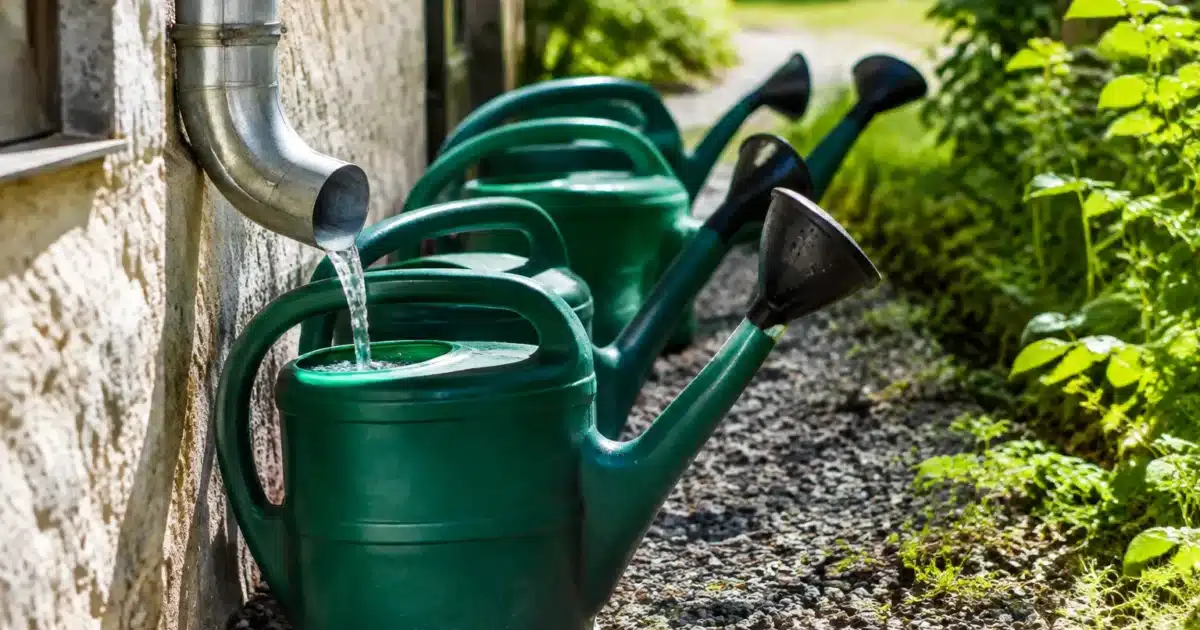
The first heavy autumn downpours are already drumming on rooftops. And while that water rushes into the gutters, your drainpipe could transform it into a free supply for all next season’s watering. A simple gutter collector is all it takes to make the difference.
On an 80 m² roof, a 20 mm rainfall (a typical autumn shower) delivers roughly 1,600 liters of water. With a rainwater harvester connected to your gutter downspout, a significant portion of that volume ends up in a tank instead of flowing into the sewers. Enough to fill dozens of watering cans without touching the tap, and without spending a penny on mains water for the garden.
Why install a gutter water collector on your downspout right now
Water restrictions multiply every summer, and many municipalities already ban hose watering on certain days. Building up a reserve before winter ensures total independence come spring, when the tanks are full and the garden is thriving again.
Landscapers know it well: rainwater, free from chlorine and limescale, suits plants far better than tap water. It preserves soil structure, prevents white deposits on leaves, and boosts vigor in flower beds and vegetable gardens alike.
The gutter harvester: a simple and affordable device
The gutter collector is a small component that fastens directly to the downspout and diverts water into a bucket, barrel, or larger tank. The principle is purely mechanical: as soon as rain falls, water is captured before it even reaches the ground. Some models filter out leaves and debris as they pass through, preventing tank buildup, provided you also follow the rule that stops overflow at your neighbor’s place.
Never kill
another plant.
Take a photo: the app names the species, spots the problem and tells you exactly what to do.
Prices remain very affordable, often between 10 and 40 euros for the collector alone. The tank itself is chosen based on garden size and intended use: occasional watering of pots on the terrace, or regular irrigation of a whole vegetable garden.
| Area to water | Recommended tank capacity |
|---|---|
| Balcony, terrace, pots | 100 to 200 liters |
| Small garden (under 50 m²) | 300 to 500 liters |
| Medium garden with vegetable patch | 500 to 1,000 liters |
| Large plot, multiple flower beds | 1,000 liters and above |
Installing your collector in 30 minutes: the key steps
Tap to scan your plant
This feature requires the Plantalya app. Scan any plant instantly with your camera!
Installation requires no special skills or heavy tools. It’s done in a few simple gestures, directly on the existing downspout.
- Locate the lowest and most accessible point of the gutter downspout, close to where the tank will sit.
- Cut a section of downspout with a fine-toothed saw, according to the dimensions specified by the collector.
- Clip or screw the collector in place, checking that the joints are watertight.
- Position the tank directly below, on a stable base and slightly elevated to make it easy to pour into your watering can.
- Check that water flows properly during the first rain and adjust if needed.
The sizing mistake that ruins system efficiency
A tank that’s too small for the roof area connected to it: this is the most common error. A 60 m² roof can collect over 1,000 liters during a single autumn downpour. With a 100-liter tank, most of that water overflows and flows back into the pipes, never reaching the garden.
The right approach is to calculate the roof area connected to your chosen downspout, then multiply by your region’s average rainfall (as shown in this mishap with a rainwater tank left full). This simple calculation prevents investing in an undersized tank, or conversely one that’s oversized for your actual needs.
Never kill
another plant.
Take a photo: the app names the species, spots the problem and tells you exactly what to do.
Water your garden year-round without touching the tap: how to manage it
Once the tank is installed, rainwater is drawn directly from the tap at the bottom, poured into standard watering cans. For the vegetable garden, this warm, chlorine-free water promotes germination and reduces water stress in young plants. On the terrace, it prevents limescale marks on pots and paving.
To get through the whole season, simply manage your reserve with common sense: water early in the morning or in the evening, mulch your plantings (see why mulch cuts vegetable garden watering needs in half), and save tap water for truly dry spells. With a properly sized tank, filled from the first autumn rains, garden self-sufficiency becomes second nature, season after season.