

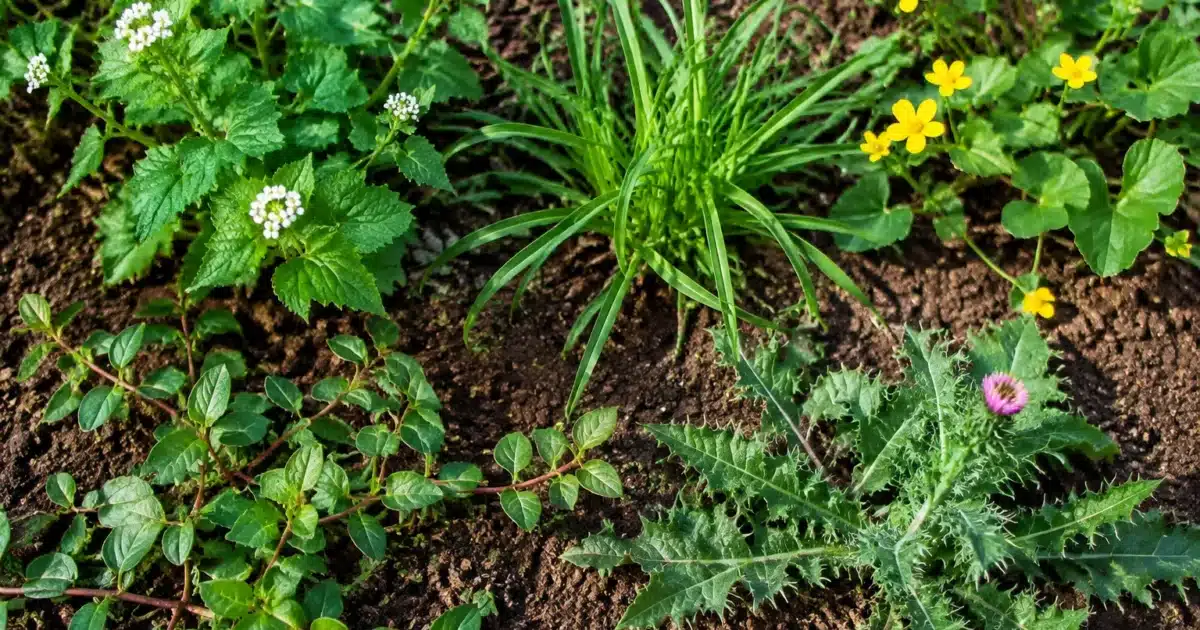
You dump a wheelbarrow of pulled weeds into the compost, feeling satisfied. Three months later, these same plants emerge, more vigorous than before, popping up all over your flower beds. It’s not by chance: certain plants survive domestic composting and become true zombie plants.
The answer comes down to five names: couch grass, bindweed, nettles in seed, Japanese knotweed (along with bamboo), and walnut. Each poses a different problem, but the result is the same: compost contamination that spreads throughout your entire garden the moment you spread it.
Why certain plants survive composting and invade your garden
A domestic compost heap rarely reaches above 40 to 50°C, often less if it’s small or poorly aerated. Yet you need to reach 60°C for several days to destroy most viable seeds and fragments of creeping roots. That’s the key difference with municipal compost, which processes tons of material and reaches much higher temperatures for much longer.
Two mechanisms explain the survival of these unwanted plants: vegetative multiplication from even the smallest piece of rhizome or root, and the production of already-ripe seeds at the time you pull them. In both cases, insufficient composting temperature merely slows the plant down, never fully killing it.
The 5 plants to absolutely ban from compost
Couch grass and creeping rhizome grasses
Couch grass is probably the worst weed to compost. Its underground rhizomes fragment easily when dug, and every piece just a few centimeters long can grow into an entire new plant. Tossed in the compost, it simply continues its life in another form, ready to restart the moment you spread finished compost on a garden bed.
Bindweed
The same logic applies to bindweed, with its creeping roots that sometimes run over a meter deep. A single fragment left in the pile is enough to launch an entire new colony. Many gardeners think they’ve eliminated it after careful weeding, only to find it the following year, scattered everywhere the compost was spread.
Nettles in seed
Young nettle, before flowering, poses no problem in compost—it decomposes very well and even enriches it with nitrogen. The problem comes when it’s in seed production: each plant can produce thousands of viable seeds, capable of surviving lukewarm composting. The result is a real carpet of nettles where you just expected to feed your vegetable garden.
Never kill
another plant.
Take a photo: the app names the species, spots the problem and tells you exactly what to do.
Japanese knotweed and bamboo
These are probably the two most problematic invasive plants in French gardens. Japanese knotweed regrows from just a few millimeters of stem or root fragment, and its growth can exceed several centimeters per day during the growing season. Running bamboo works the same way, with rhizomes capable of crossing a pathway or patio. Neither should ever end up in a domestic compost pile, even a hot one.
Walnut, due to juglone
Walnut doesn’t invade through roots in compost, but its leaves contain juglone, a substance toxic to many vegetable plants like tomatoes and potatoes. This molecule breaks down slowly and can inhibit germination and growth of plants fertilized with this compost, long after the leaves have been incorporated.
The hurried gardener’s common mistake
Tap to scan your plant
This feature requires the Plantalya app. Scan any plant instantly with your camera!
Scan Your Plant — Download Free AppMany think that simple shredding solves the problem. In reality, shredding fragments couch grass or knotweed rhizomes but doesn’t kill them: it actually multiplies the number of possible regrowth by dispersing more viable fragments throughout the pile.
How to manage these stubborn plants without risking invasion
For these tough weeds, several solutions exist outside your garden compost, to be considered alongside the fact that roots from old vegetable garden crops don’t always need to be pulled up. Complete desiccation in the sun on a black tarp for several weeks destroys most roots and seeds before disposal. Solarization, which involves trapping plants under clear plastic in full summer heat, generates enough temperature to overcome certain persistent weeds.
Never kill
another plant.
Take a photo: the app names the species, spots the problem and tells you exactly what to do.
The simplest option often remains directing these waste materials to a municipal compost or waste facility that processes vegetation at scale, with sustainably high temperatures. For small quantities, your household trash is an acceptable option, even though it deprives your garden of organic matter that could have been recycled elsewhere.
| Plant | Main risk | Recommended solution |
|---|---|---|
| Couch grass | Regrowth from rhizome | Desiccation or trash |
| Bindweed | Deep creeping roots | Waste facility / municipal compost |
| Nettle in seed | Viable seeds | Cut before flowering, otherwise trash |
| Japanese knotweed / bamboo | Stem or rhizome fragments | Specialized waste facility |
| Walnut | Toxic juglone | Separate long composting, or waste facility |
A few golden rules for healthy, controlled compost
Effective composting begins with sorting at the source: reserve it for vegetable scraps, fresh clippings, fallen leaves, and weeds not yet in seed. Regularly turn the pile to even out temperature and speed decomposition, and avoid throwing everything from your garden into it without thinking.
When in doubt about a plant, it’s better to keep it out of the pile than risk compost contamination that will later spread to every plot where you use it—a problem that often ties back to the common causes of compost odor problems. Controlled compost beats an overrun garden.


