Just as with the stem to cut on raspberry canes after harvest, a poorly pruned currant bush can produce up to half as many fruits as a well-maintained shrub. The reason is straightforward: redcurrants, whitecurrants, and gooseberries do not fruit everywhere on their branches. Removing the bad ones now, at the right time and using the correct technique, directly determines the quantity of clusters you will harvest the following year.
Why pruning currants determines tomorrow’s harvest
Currant fruiting concentrates on young wood, typically one to three years old. Beyond that stage, shoots aged three years and older gradually become unproductive wood: they continue to grow but yield increasingly fewer fruits. A shrub left unattended eventually accumulates aging wood, at the expense of young growth-bearing clusters.
By removing this tired wood each year, you force the plant to concentrate its sap in the most productive shoots. This is exactly the principle used in Polish orchards, renowned for their high fruit yields on blackcurrants and currants: regular and selective pruning, never drastic pruning all at once.
When to prune your currants: two critical windows to respect
Two periods allow for effective intervention, and they do not replace one another (each addresses a different objective in the plant’s cycle, as with the right month to prune hedges without hindering their regrowth).
Winter pruning before March: the Polish orchard rule for productive yields
Winter pruning is done during dormancy, ideally between December and late February, before the sap rises. This is when you structure the shrub in depth: remove overly old framework branches, open up the center, and balance the number of shoots by age. The rule applied in many orchards is to keep one-third of one-year-old wood, one-third of two-year-old wood, one-third of three-year-old wood, systematically removing anything that exceeds this.
This pruning before March has a direct effect on spring flowering and therefore on fruit-setting that follows a few weeks later.
Summer pruning after harvest: boost vigor for next year
Once the clusters are picked, usually in July, a second lighter intervention allows you to shorten the year’s shoots and eliminate vigorous growth that exhausts the shrub without benefit. This summer pruning promotes shrub vigor and prepares better light conditions for the buds that will produce the next harvest.
Identifying bad branches: what to remove now
Before cutting, you must know how to recognize branches that penalize production. Several telltale signs don’t lie: gray, cracked bark, weak growth, brittle wood that produces only a few scattered leaves. These shoots aged three years and older must be removed at the base, even if they still appear alive.
Never kill
another plant.
Take a photo: the app names the species, spots the problem and tells you exactly what to do.
You must also monitor the center of the bush. An overly dense core prevents light from penetrating, which harms center aeration and promotes fungal diseases, particularly dreaded on gooseberries. Finally, branches that cross each other, touch the ground, or grow inward should systematically be eliminated, regardless of their age.
The simple guide to avoid choosing the wrong branch
If the wood is still supple and light under the bark when you score it lightly, it’s young wood to keep. If it’s dull, dry, and snaps cleanly, it’s unproductive wood to remove without hesitation.
Tap to scan your plant
This feature requires the Plantalya app. Scan any plant instantly with your camera!
Scan Your Plant — Download Free AppStep-by-step method for effective currant pruning
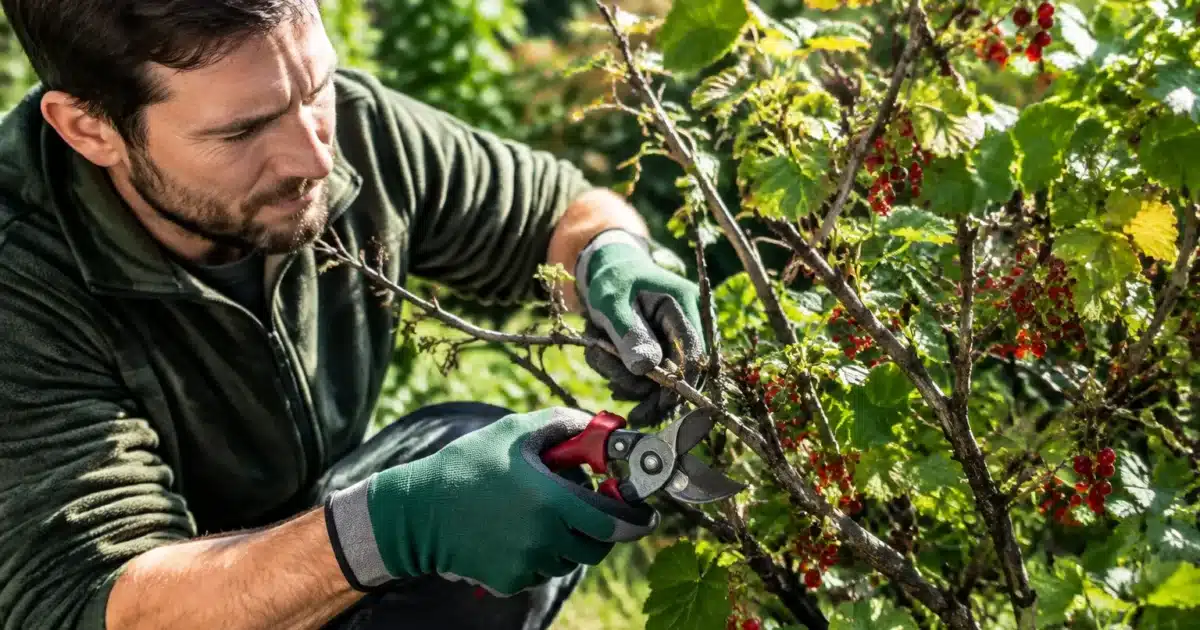
Technique matters as much as branch selection. A sharp, disinfected pruner avoids crushing fibers and limits disease transmission from one plant to another. Each cut must be clean, slightly angled, just above a bud facing outward from the bush to promote open growth.
- Start by removing all dead, broken, or diseased wood without exception.
- Next, remove shoots older than three years, at ground level or from the main framework.
- Thin the center by removing branches that cross or grow inward.
- Finish by balancing the silhouette to achieve an airy, open-centered bush.
On blackcurrants, fruiting occurs more on one-year-old wood, which justifies slightly more severe pruning than on red or whitecurrants, where you preserve more two to three-year-old shoots bearing clusters (a principle similar to that described for raspberry canes still bearing fruit).
Pruning mistakes that sabotage next year’s harvest
The most common mistake is to prune only at the branch tips, forming a dense ball, never removing wood at the base. Result: the plant exhausts itself producing mainly leaves, at the expense of fruit. Another classic error is pruning too late in spring, once sap is already rising: wounds then heal poorly and the shrub experiences unnecessary stress that delays flowering.
Finally, cutting all shoots to the same height, without distinguishing their age, uniformizes the shrub but destroys the balance between young and productive wood sought in successful pruning.
Never kill
another plant.
Take a photo: the app names the species, spots the problem and tells you exactly what to do.
Care after pruning: watering, mulching, and fertilizing to maximize fruit
After pruning, even light pruning, the shrub needs support to restart under good conditions. Organic mulch placed at the base limits water evaporation and protects roots from temperature fluctuations, while slowly decomposing to nourish the soil.
An application of organic fertilizer at the start of growth, rich in potassium, supports cluster formation rather than excessive foliage development. Regular watering, especially during the weeks following cut healing, helps the plant concentrate its energy on regrowing young shoots that will bear the next abundant harvest.