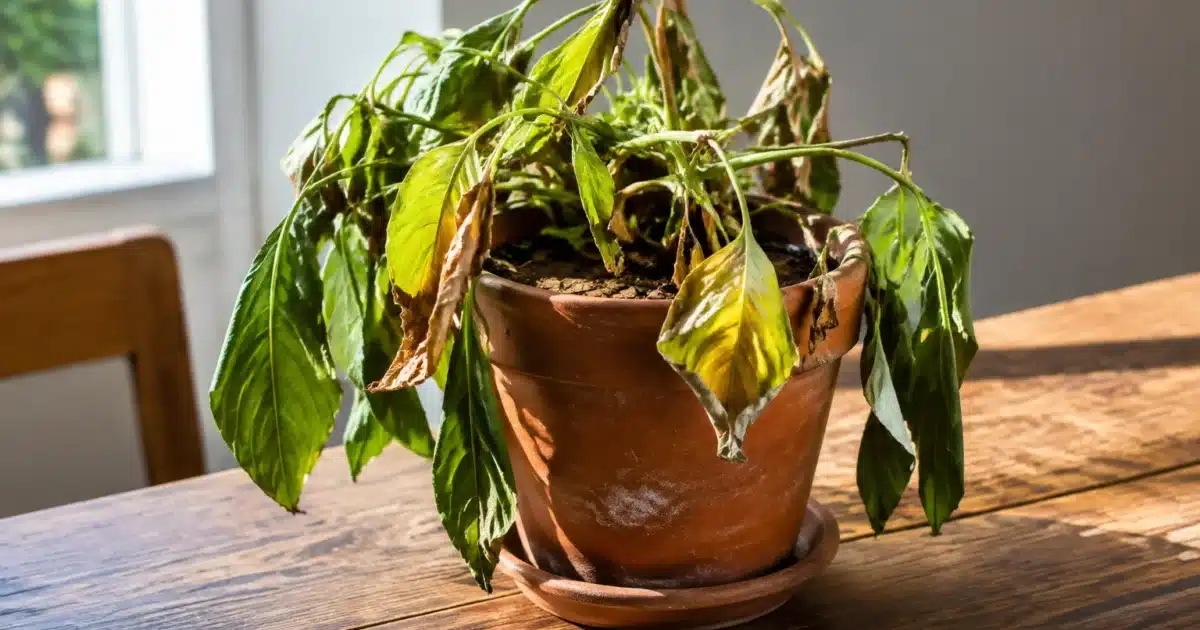
A wilting plant, yellowing leaves, stagnant growth: the usual reflex is to grab the first fertilizer at hand. Big mistake. During periods of intense heat, fertilizing an already stressed plant often amounts to exhausting it further, or even burning its roots.
The rule is simple to remember: fertilizer doesn’t repair fatigue caused by heat or lack of water. It only serves to fill a proven nutrient deficiency, when the plant is growing actively and has enough water to absorb what you give it. If the soil is dry and the plant is in water stress, any application of mineral or liquid fertilizer risks root burn rather than a performance boost.
Why not fertilize automatically in summer?
A plant suffering from extreme heat puts its growth on pause. It’s a survival strategy: it closes its pores, slows its photosynthesis, conserves its resources. Giving it nitrogen or any other nutrient at that moment is asking it to produce new leaves when it doesn’t even have enough water to maintain the ones it already has.
The result is often the opposite of what’s hoped for: mineral salts from the fertilizer accumulate in soil that’s already dry, which increases salt concentration around the roots. The plant then loses even more water through osmotic pressure, and the stress worsens instead of subsiding.
Recognizing real needs: signs of deficiency vs stressed plant
Symptoms of genuine deficiency
A true nutrient deficiency shows itself through precise and gradual signs, independent of current weather. Chlorosis (yellowing between the veins, which remain green) often indicates a lack of iron or magnesium. Uniformly yellow leaves, starting from the bottom of the plant, suggest an nitrogen deficit instead. In both cases, the plant continues to grow, but slowly, and new growth is pale or small.
Plants in thermal or water stress: fertilizer forbidden
If leaves droop, curl up, or brown at the edges after a heat wave or a watering lapse (as detailed in this late watering that can kill your plants in late August), it’s not a deficiency but acute water stress. In this specific case, water is the absolute priority, not nutrients. Water deeply, early morning or evening, and wait for the plant to regain vigorous foliage before considering any fertilizer application.
Many gardeners confuse wilting caused by heat with nutritional deficiency. They fertilize a thirsty plant, which concentrates salts in soil that’s already dry and accelerates root dehydration. The right reflex: always water first, observe for 48 hours, and fertilize only if symptoms persist despite good hydration.
Never kill
another plant.
Take a photo: the app names the species, spots the problem and tells you exactly what to do.
Which plants actually benefit from summer fertilizer?
Vegetables in production, repeat-flowering roses, potted plants
Some plants continue to work hard in summer and deserve nutritional support. Vegetables in full production, tomatoes, zucchini, eggplants, draw heavily from the soil to form their fruits: regular applications every ten to fifteen days support their yield without excess. Repeat-flowering roses, which reflower after an initial wave, also appreciate a light boost to restart blooming.
Signs in pots indicating you need to reduce watering deserve particular attention. Confined to limited soil volume, they quickly exhaust substrate reserves and depend almost entirely on outside inputs. A diluted liquid fertilizer, applied with irrigation water once or twice a month, suits them well as long as the pot isn’t under water stress.
Tap to scan your plant
This feature requires the Plantalya app. Scan any plant instantly with your camera!
Perennials, shrubs, lawn in dormancy: no application
Conversely, well-established perennials and shrubs that have been in place for several years have a root system developed enough to draw what they need from the surrounding soil. Fertilizing them in summer generally adds nothing except the risk of tender, water-hungry growth just before intense heat peaks.
The lawn deserves special mention. In summer, especially during drought peaks, it enters dormancy: it yellows to protect itself, not because it lacks fertilizer. Fertilizing a dormant lawn only forces growth that the plant naturally refuses, with real risk of burning grass blades already weakened (see also when to reseed lawn burned by heat wave).
Which type of fertilizer to choose in summer (and how to apply it)?
| Fertilizer type | Advantage | Precaution |
|---|---|---|
| Organic fertilizer | Slow release, lower burn risk | Delayed effect, requires planning |
| Mineral fertilizer | Quick action on visible deficiency | High root burn risk if soil is dry |
| Liquid fertilizer | Easy to dose, rapid absorption | Must be diluted, never on dry soil |
Organic fertilizer remains the safest choice in summer. Its slow release avoids peaks in salt concentration and gradually feeds soil microorganisms, which themselves transform organic matter into assimilable nutrients. It’s a gentler cycle, more respectful of the plant’s rhythm.
If mineral or liquid fertilizer is used, it should always be applied to soil that’s been pre-moistened, never to dry, cracked earth. Diluting beyond the recommended dose during hot periods also limits the shock risk to roots.
Never kill
another plant.
Take a photo: the app names the species, spots the problem and tells you exactly what to do.
Alternatives to fertilizer: mulch and soil health
Before even thinking about fertilization, mulch remains the most effective tool for getting through summer without stressing plants. A layer of five to eight centimeters limits evaporation, maintains more stable soil temperature, and progressively nourishes the soil as it decomposes.
Living soil, rich in microorganisms, naturally transforms organic matter into nutrients available at the right pace, without the peaks and dips of one-time chemical application. Taking care of this underground life, through regular mulching and appropriate watering, often reduces the need for fertilizer better than any product could.