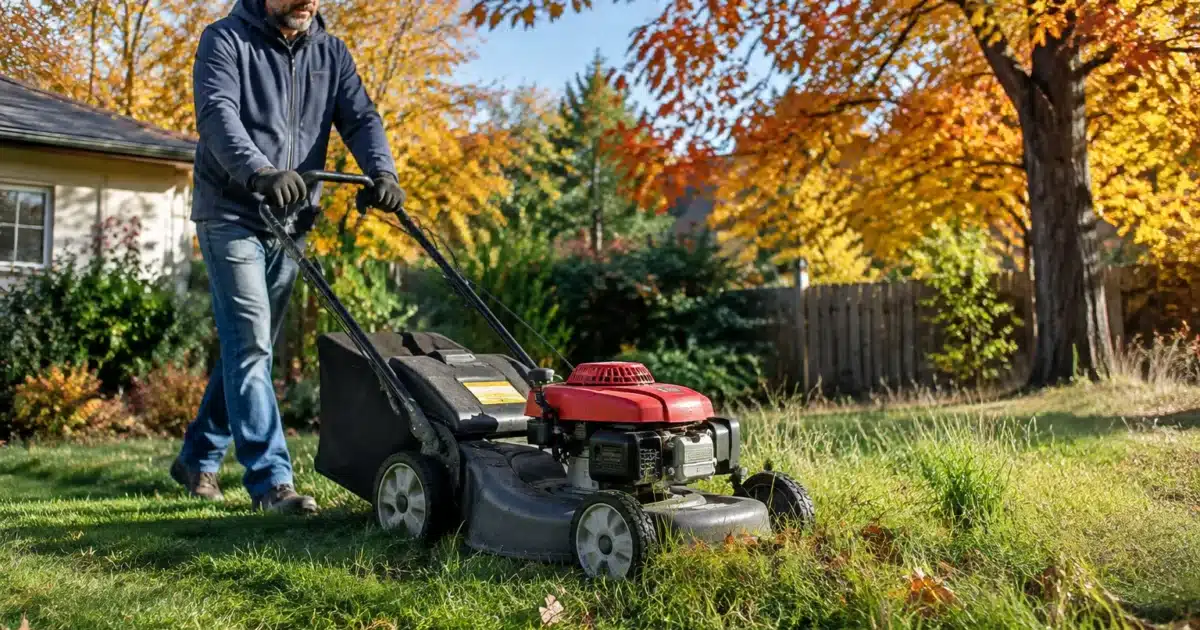
You’re getting the mower out one last time before putting it away for winter, and your natural instinct would be to cut short, just as you’ve done all summer. That’s precisely the mistake to avoid, as explained in the article on why you shouldn’t mow your lawn short in autumn anymore. Your final mow before the cold months must not be cut as short as summer grass, as you risk permanently weakening your lawn against frost.
In summer, a close cut limits evaporation and keeps the grass neat. In autumn, the logic completely reverses: grass blades need length to continue photosynthesis and rebuild root reserves before winter dormancy sets in.
The ideal cutting height for your final autumn mow
The rule to remember is straightforward: aim for a cutting height between 5 to 6 cm for your last mowing of the season. This is the threshold that allows your lawn to retain enough leaf surface area to capture available light without becoming overly tall and creating other problems.
The 5 to 6 cm rule: why it’s the optimal threshold
At this height, grass blades retain enough foliage to continue photosynthesis while soil temperature permits. This mechanism feeds root reserves with sugars, essential for surviving winter and regrowing vigorously in spring. A lawn mowed too short at this time simply doesn’t have enough green matter to produce these reserves.
Adjust height based on grass type
An ornamental lawn, dense and fine-textured, can tolerate a slightly lower cut, around 4.5 to 5 cm, since it naturally remains more resilient thanks to its density. A hardy lawn, more often used in high-traffic areas, benefits from staying around 6 cm to better withstand winter foot traffic and bad weather. In shaded zones, where light is already scarce, it’s best to stick to the higher end of the range to compensate for the photosynthesis deficit.
| Grass Type | Recommended Height | Characteristic |
|---|---|---|
| Ornamental lawn | 4.5 to 5 cm | Natural protective density |
| Hardy lawn | 5.5 to 6 cm | Better resistance to traffic |
| Shaded area | 6 cm | Compensates for lack of light |
Risks of mowing too short late in the season
A close cut just before the first frosts exposes roots directly: without sufficient leaf protection, soil cools faster and frost more easily reaches the plant’s crown, its most sensitive zone. Roots, already weakened by lack of reserves, struggle to survive temperature fluctuations. Come spring, you’ll see yellowed, sparse patches, sometimes completely dead areas needing reseeding.
Too short a cut also encourages moss and fungal disease development, since bare soil retains more stagnant moisture without foliage to regulate it.
Risks of leaving grass too tall before winter
Never kill
another plant.
Take a photo: the app names the species, spots the problem and tells you exactly what to do.
Conversely, letting it grow without ever mowing isn’t a good idea either. Overly long grass collapses under snow or cold rain weight, creating damp, compacted zones prone to thatch buildup. This mat of flattened blades prevents soil aeration and becomes ideal breeding ground for fungi.
Spring thaw aggravates the problem further: water pools under this dense layer and causes characteristic brown patches, sometimes called snow mold. A lawn that’s neither too short nor too tall remains your best bet for safely getting through winter.
The classic summer habit mistake
Tap to scan your plant
This feature requires the Plantalya app. Scan any plant instantly with your camera!
Many gardeners keep the same mower setting throughout the season. But the cut that worked fine in July, often between 3 and 4 cm, becomes dangerous by October. Remember to raise the blade before your final mowing.
When to do your final mow and how to gradually reach the right height
The right time to stop mowing depends less on the calendar than on observation, a point detailed in our guide on the temperature at which to stop mowing. As long as grass growth continues, meaning soil temperature stays above 8 to 10°C, occasional mowing remains useful. Below that, grass virtually stops growing and continuing to mow becomes pointless, even harmful.
It’s advisable not to jump abruptly from a short cut to 5–6 cm in a single pass. A gradual mowing approach, with progressive height reduction over two or three passes spaced a few days apart, lets your lawn adapt without stress. Raising cutting height by 1 cm with each pass avoids too sudden a shock to the plant.
Complementary steps after your final mow
Never kill
another plant.
Take a photo: the app names the species, spots the problem and tells you exactly what to do.
Before permanently storing your mower, a final scarifying pass removes accumulated moss and thatch from the season, promoting better soil respiration. An application of autumn fertilizer, rich in potassium and low in nitrogen, strengthens frost resistance without stimulating unnecessary growth at this time.
Mulching can also be a smart choice for this final mow: fine cut residues decompose and feed the soil while forming light protection against temperature swings. Also check your mower’s blade sharpness before this last pass: a dull blade tears grass instead of cutting cleanly, creating wounds that further weaken the plant just before winter.
These simple steps provide real winter protection for your winter lawn. The results show when warm weather returns: thick, green grass ready to flourish, without the yellow patches that betray a final cut that was too rushed and poorly timed.